

The Plant School - Trees for a Changing Climate
Over the next ten months, we’ll be sharing some of the insights, conversations and lessons emerging from The Plant School’s Tree Course.
Across ten study days, the course brings together expert knowledge, discussion and visits to some remarkable tree collections, exploring everything from tree biology and species selection to establishment, management and the future of trees in our changing climate. We’ll be sharing some of the things that particularly resonate with our work as landscape architects - and how they might influence the landscapes we design today for the decades ahead.
The first study day took place at Kew Gardens, exploring tree selection, specification and how established trees are responding to increasingly variable weather conditions. Drought, heat, extreme rainfall and wildfire are becoming increasingly important considerations alongside the traditional horticultural qualities of a tree, raising questions about the species being specified and planted today.
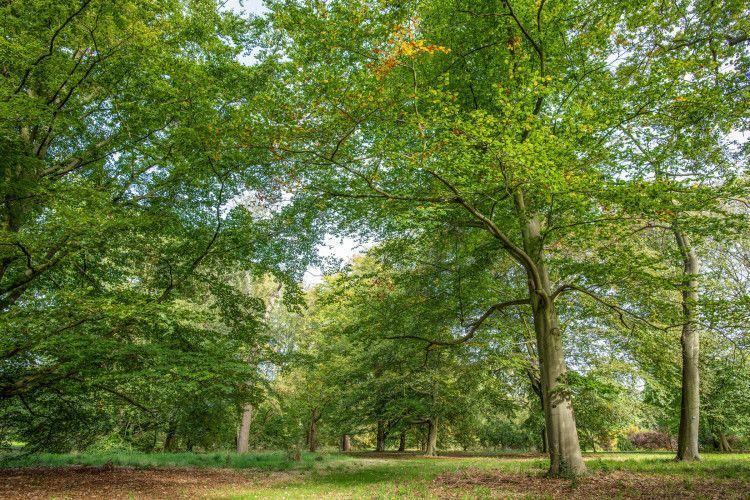
The condition of individual specimens at Kew provided some useful insights. One example of Fagus sylvatica, our native beech, was showing clear signs of drought stress, with sparse foliage and scorched leaves. Beech is particularly associated with the chalk landscapes of southern England, but increasingly warm and dry conditions may place greater pressure on the species, particularly where soils are shallow and moisture availability is limited.
Fagus orientalis, native to southeastern Europe, offers one potential alternative, with characteristics that may make it better suited to warmer conditions. However, availability remains an important consideration. Developing sufficient nursery production of appropriate species and provenances will be essential if the industry is to respond effectively to changing conditions.
Similar questions arise in relation to oak. While Quercus robur remains an important native species, alternatives such as Quercus ilex and Quercus suber (Cork Oak) may have an increasing role in future planting. Quercus suber is particularly notable for its thick, fire-resistant bark and potential suitability for hotter, drier conditions. Acer sempervirens was another species considered as a potential alternative to the more familiar Acer campestre, which is a British native.
Other species demonstrated different forms of resilience. Taxus baccata offers good drought tolerance, while Platanus × hispanica remains highly successful in urban environments due to its tolerance of pollution and difficult growing conditions. Fraxinus excelsior continues to face the significant challenge of ash dieback, while species including Ginkgo biloba, Corylus avellana, Cedrus and Robinia offer further possibilities for consideration.
The objective is not to replace native trees, but to broaden the palette of species available to landscape designers and horticulturists. Greater diversity can help reduce reliance on individual species and increase the resilience of landscapes as conditions change.
This will inevitably influence the visual character of the British landscape. Trees with different forms, foliage, seasonal qualities and ecological characteristics will become increasingly familiar within our towns, gardens and wider countryside.
Understanding species performance, provenance, nursery availability and natural regeneration will therefore be fundamental to creating robust, resilient landscapes for the decades ahead.
What does this mean for landscape design?
Andrée’s observations at Kew highlight an important challenge for landscape architects: how do we design landscapes today that will continue to thrive in a climate that may be very different in 50 years’ time? For our team, and the wider profession, this raises three important considerations:
- Challenging the brief. As our understanding of tree performance evolves, so must the advice we give clients. Climate resilience needs to inform early design decisions, balancing biodiversity, local character and future conditions. Our role is to challenge assumptions and help clients make informed choices.
- Connecting design with nursery production. A key point raised at this year’s FutureScape was the need for closer collaboration between designers and growers. Andrée’s observations reinforce this. Understanding species availability, provenance and lead times early on can help make our designs deliverable while encouraging nurseries to grow a wider range of climate-resilient trees.
- Designing landscapes that can evolve. As Andrée highlights, our landscapes will inevitably change. We need to design for adaptation, considering establishment, long-term management and natural regeneration. This will help create landscapes that retain their identity while adapting to future climatic conditions.
Next month…
Andree will be visiting the Savill Garden, where she will continue to share the conversations, observations and insights emerging from The Plant School’s Tree Course.